


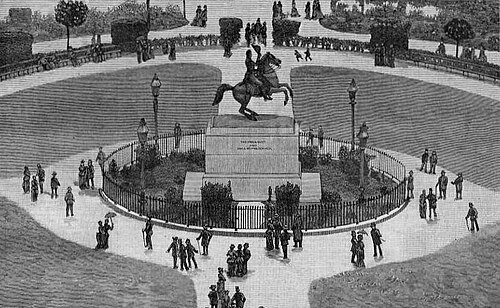
American sculptor Clark Mills is best remembered for creating the iconic equestrian statue of Andrew Jackson that stands in the center of Jackson Square. Although largely self-taught, Mills won a national competition in 1848 to design a monument honoring Jackson’s victory at the Battle of New Orleans. His original bronze statue was dedicated in Washington, D.C., on January 8, 1853, and was celebrated as the first equestrian statue cast in bronze in the United States. Even more remarkably, it was the first equestrian bronze statue in the world engineered to balance entirely on the horse’s two hind legs.
The popularity of the monument in Washington D.C. led Mills to produce additional castings. The New Orleans version was installed in Jackson Square and dedicated in 1856, placing the city’s celebrated military hero at the heart of the historic French Quarter. The statue depicts Jackson raising his hat as he reviews his troops before the Battle of New Orleans, a moment that cemented both his national reputation and his lasting connection to the city.
Today, Mills’ sculpture remains one of New Orleans’ most recognizable landmarks. While interpretations of Andrew Jackson’s legacy have evolved over time, Clark Mills’ engineering and artistic achievement continues to be recognized as a milestone in American sculpture and bronze casting.
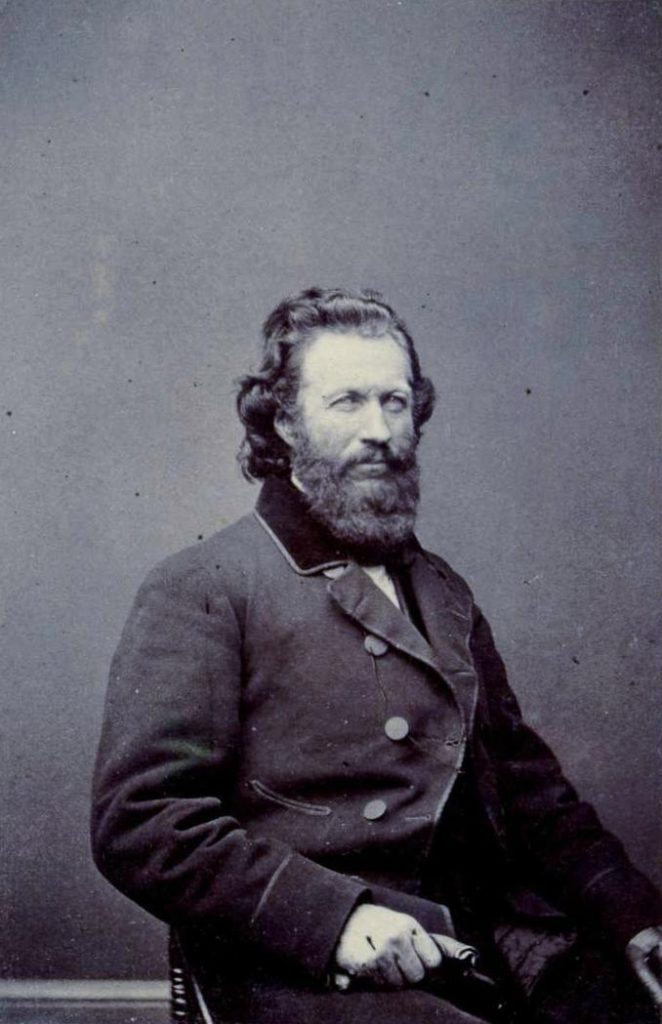
Clark Mills (1815–1883). Photograph by Mathew Brady’s National Portrait Gallery, ca. 1860–1865. Courtesy of the U.S. National Archives / Wikimedia Commons. Public Domain.

Comments are closed